


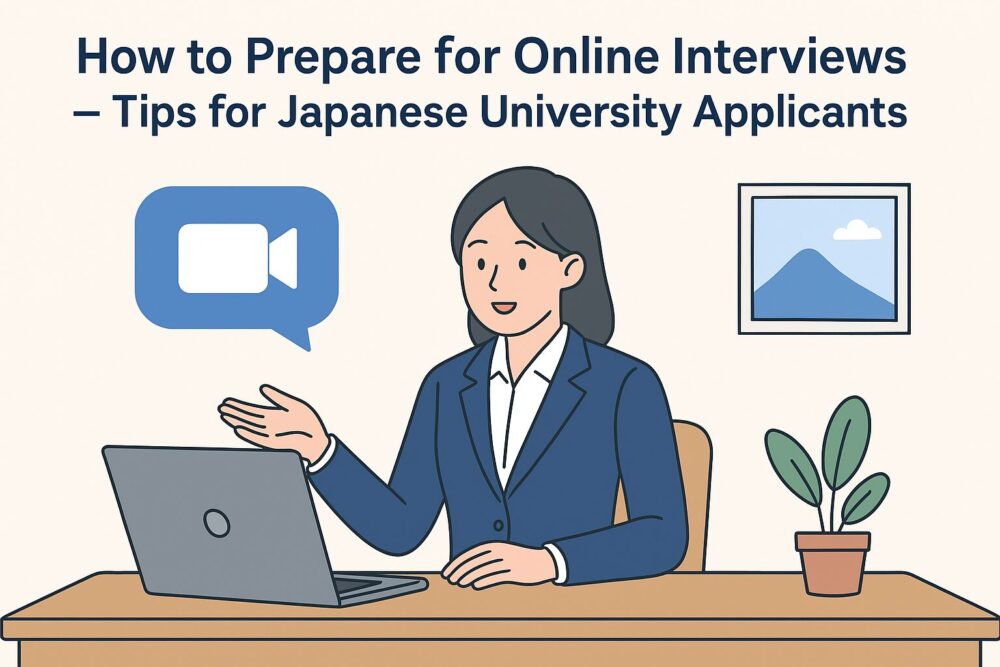
Based on my working experience as an admissions officer at university in Japan, I would like to share some tips for university entrance examinations (online).
Set up your environment for an online interview
First and foremost, make sure you are in a quiet, private room. Ideally, your background should be a plain wall. If bookshelves or other objects are visible behind you, they may unintentionally send distracting messages to the interviewers.
Position your computer camera at eye level or slightly above. This helps your gaze appear naturally upward and engaged. If the camera is placed below your eye level, your eyes may look downward, which can give a less favorable impression.
Lighting is a crucial factor when preparing for an online interview. It greatly affects how you appear on screen. Choose a bright room, and if possible, use a light source that shines directly on your face to make your expression look clear and lively. It’s obvious which candidate will leave a better impression: one in a well-lit room or one in a dark room.
Be sure to check your internet connection and microphone volume in advance with someone else. During the interview, silence your phone and inform your family of the interview time so they can help maintain a quiet environment.
What to Wear for Your Interview
There are usually no strict dress codes for university interviews, but it’s best to avoid clothing with loud or flashy patterns. In Japan, many students choose to wear their school uniforms for online interviews, and this is generally seen as appropriate. Interviewers are unlikely to view uniforms negatively.
For students who do not have a school uniform, wearing a collared white shirt is also a safe and respectful choice. Clothing is one way to express yourself and shape the impression you give to others. Choosing an outfit that reflects your personality can be a strategic decision.
Ultimately, it’s important to think about how you want to be perceived and select your interview attire accordingly.
How to Respond Effectively in a University Interview
Speaking clearly and with a positive tone leaves a good impression. It’s important to answer each question directly and confidently—but many applicants struggle with this. Superficial answers won’t satisfy the interviewers.
Instead, try to base your responses on your own experiences and include specific examples. Keep your answers concise and focused on the main point. If the interviewers want more details, they will ask follow-up questions. Remember, you are not the only person being interviewed. Giving short, clear answers based on your personal experience is key.
During the interview, make sure to look into the camera—not at the image of the interviewers on your screen. If you are looking at something else other than the camera such as notes, the interviewer will notice. Try to keep your eyes on the camera as much as possible.
You will likely be asked about your motivation for applying. Be sure to review the admission policy of the faculty you are applying to, and prepare answers that show how your qualities match what the faculty is looking for. (Of course, you should have already reviewed the admission policy when choosing your desired faculty.)
Be ready to explain, in your own words, why you want to study in Japan, and why you chose that particular university and faculty over others. You should also be able to describe what you hope to learn during your studies and how you plan to connect that learning to your future career.
Interviewers are responsible for evaluating whether applicants match the type of student the university and faculty are seeking—within a limited amount of time. Understanding this role will help you prepare more effectively for the interview.
What to Do in Case of an Emergency During Your Interview
If your computer freezes during the interview or you realize you’ve made a mistake with the interview time, contact the university immediately. A phone call is the most effective method, but if you cannot reach them by phone, you must send an email without delay.
Before the interview, make sure you have a reliable way to contact the university in case something unexpected happens. Being prepared for emergencies is an important part of your interview readiness.
🍀Good luck for your interview ahead.
