
In a previous post, I introduced the news that the University of Idaho will open a branch campus this August inside Hiroshima University in Higashihiroshima City. In an interview with Nikkei, Hiroshima University Vice President Professor Kaneko pointed out that Japanese universities still offer very few undergraduate programs that can be completed entirely in English. As a result, Japan has fallen behind South Korea and Taiwan in attracting talented high school students from around the world. He emphasized the need for Japanese universities to expand English-taught degree programs in the coming years.
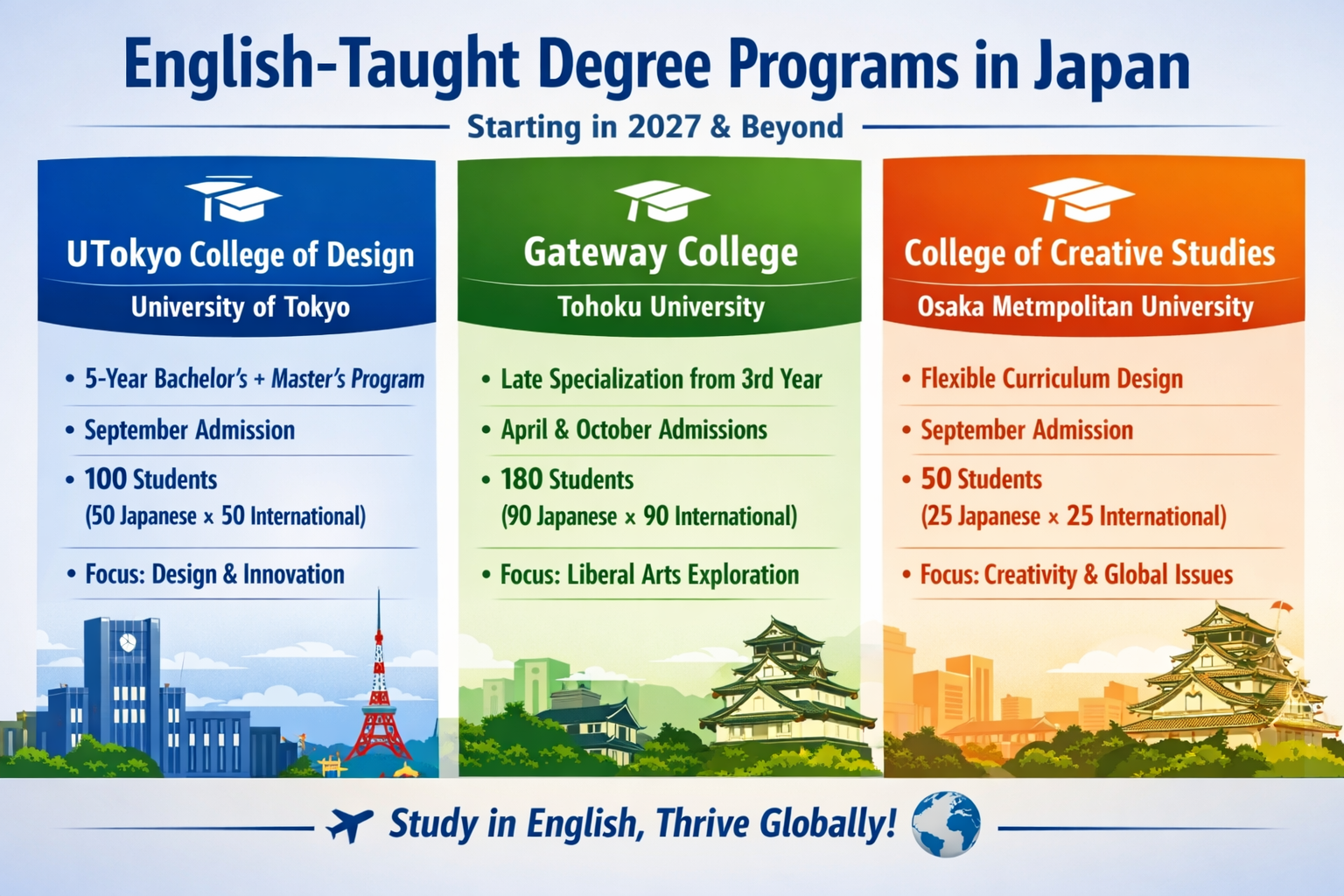
This time, let’s look at three new English-degree programs scheduled to launch in Japan from 2027 onward.
The University of Tokyo: UTokyo College of Design
Tokyo University plans to open a new undergraduate program in September 2027 — its first new faculty since the Faculty of Pharmaceutical Sciences was established in 1958, nearly 70 years ago. This five-year integrated bachelor’s and master’s program is attracting significant attention as Japan’s top university responds to the challenges of a rapidly changing world.
Key Features
- Five-year integrated program (Bachelor + Master). Outstanding students can complete both degrees within five years through an accelerated master’s track.
- September admission.
- 100 students (approximately 50 Japanese and 50 international).
- All courses taught in English.
- Residential system for first-year students.
The name “UTokyo College of Design” reflects the university’s ambition to nurture the ability to design society itself, not just physical objects. In an interview with Asahi Shimbun (February 2026), Vice President Toshihiko Koseki explained:
“Design is often associated with shaping cars or interiors. But fundamentally, design means balancing human desires, needs, and environmental constraints to find optimal solutions. Today, design thinking is increasingly required in business management and policy-making. As society grows more complex and individual needs diversify, solving social issues demands connecting knowledge across disciplines. The University of Tokyo aims to link its broad academic expertise through design approaches, fostering people who can create new systems and tackle social challenges.”
Tohoku University: Gateway College
Tohoku University will launch its first interdisciplinary undergraduate program that does not assign students to a specific faculty upon admission. The name “Gateway” symbolizes an entry point — a place where students can explore various academic fields before choosing their specialization.
Key Features
- Students do not belong to a specific faculty at admission. During the first and second years, they study a wide range of subjects across humanities and sciences, then select their major from the third year onward.
- April and October admissions, with a total of about 180 students. The April intake aligns with Japan’s academic calendar, while the October intake suits international systems. Approximately 88 students enter in April and 92 in October.
- All courses taught in English.
- Roughly equal ratio of Japanese and international students.
- First-year students live in the university’s international dormitory.
The program aims to cultivate globally minded individuals who can think flexibly across disciplines and contribute to solving complex global issues.
Osaka Metropolitan University: College of Creative Studies (tentative name)
Osaka Metropolitan University plans to open the College of Creative Studies in September 2029 as an English-taught undergraduate program. After foundational language training in the first year, students will design their own curriculum from 80–100 courses in fields such as biotechnology, data science, and tourism. The program encourages exploration of issues ranging from local challenges like depopulation and urban development to global topics such as climate change.
Key Features
- Numerous project-based courses in collaboration with local governments and companies.
- All courses taught in English.
- Japanese language education and internship programs for international students.
- Problem-based learning (PBL) linked to regional and industrial issues.
- September admission.
- 50 students (25 Japanese and 25 international).
In an interview with Nikkei, Vice President Professor Takahashi emphasized that the university will leverage local resources around Osaka Castle’s eastern district to train students in practical urban problem-solving. He stated, “We aim to nurture individuals who can drive social transformation across diverse fields, not just acquire specialized knowledge.”
These three programs — at the University of Tokyo, Tohoku University, and Osaka Metropolitan University — represent Japan’s new wave of higher education reform. They share a common vision: to make Japan a destination where students from around the world can earn degrees entirely in English while engaging in globally relevant, interdisciplinary learning.
